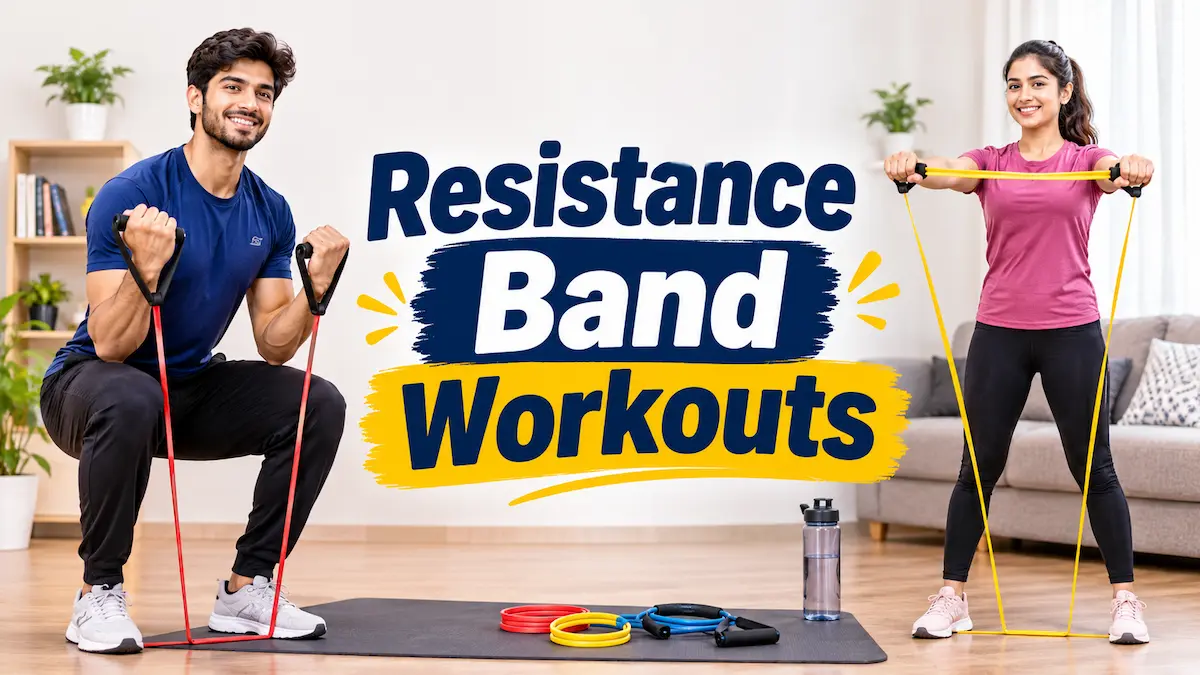
A set of bands costs less than a month of most gym memberships, weighs less than a bag of flour, and fits in a drawer. Yet people overlook them because they look too simple to do much. That’s a shame, because resistance band workouts are one of the easiest ways to train your whole body when you have a small flat, a shared room or a hotel floor and not much else.
This guide gives you a complete routine built around six moves, a simple three-day plan, ways to make it harder as you improve, and a few honest notes on what bands can and can’t do.
Do Resistance Band Workouts Actually Build Strength?
Short answer: yes, for most people, and especially if you’re starting out or getting back into training.
A systematic review in SAGE Open Medicine pulled together eight randomized trials with 224 participants and compared elastic resistance training with conventional resistance training. It found that elastic bands produced similar strength gains to conventional training for both upper and lower limbs. The authors suggested bands could be a low-cost, accessible option.
Now the fine print. The studies were small and of low to moderate quality, and the band loads weren’t always standardized, so this isn’t the last word. Bands also feel different from weights: the resistance gets heavier as the band stretches, so the hardest part of a rep is at the end. That’s fine for most goals. If you’re an experienced lifter chasing maximum strength, you will probably want heavier loads too. For everyone else, bands are a genuinely useful tool.
It also helps to know what you’re aiming for. The CDC says adults need 2 days of muscle-strengthening activity each week that works all the major muscle groups: legs, hips, back, abdomen, chest, shoulders and arms. The routine below covers all of them in one session.
What You Need (and How Much Room)
Space: roughly the footprint of a yoga mat. If you can stretch both arms out without hitting a wall, you have enough.
Bands: you do not need a big kit. Two types cover almost everything:
- Tube bands with handles, ideally with a door anchor. Good for rows, presses and curls.
- Loop bands (mini bands), the flat circles. Good for legs, glutes and shoulder work.
Buy two or three resistance levels. A light band for shoulders and arms, a medium one for most upper-body moves, and a heavier one for legs. Your legs are stronger than your arms, so they’ll need more resistance.
Safety basics:
- Check the band for nicks, cracks or thin spots before each session. Replace it if it looks worn.
- Make sure any anchor point is secure. Test it with a firm tug before you commit to it.
- Control the release. Don’t let a stretched band snap back, and keep it away from your face.
The Full Routine: 6 Moves, One Small Space
Do each move for 10 to 15 controlled reps. Move through all six for one round, rest for a minute or so, then repeat for 2 to 3 rounds. Expect about 20 to 25 minutes.
Go slowly, especially on the way back. Letting the band pull you back fast wastes half the exercise.
1. Banded Squat (legs and glutes)
Stand on the middle of a tube band, holding the handles at shoulder height (or place a loop band just above your knees). Sit your hips back and down, keeping your chest up and your knees tracking over your toes, then stand tall.
Easier: use a lighter band or squat to a chair. Harder: add a 2-second pause at the bottom.
2. Banded Row (back and biceps)
Sit on the floor with your legs out, loop the band around your feet and hold the ends. Keeping your back straight, pull your elbows back and squeeze your shoulder blades together, then return slowly.
Easier: bend your knees. Harder: hold the squeeze for 2 seconds on each rep.
3. Standing Chest Press (chest, shoulders, triceps)
Wrap the band around your upper back, holding an end in each hand. Start with your hands near your chest, then press forward until your arms are straight. Step into a staggered stance to stay stable.
Easier: use a lighter band. Harder: slow the return to 3 seconds.
4. Overhead Press (shoulders)
Stand on the band with the handles at shoulder height, palms facing forward. Press straight up without arching your lower back, then lower under control.
5. Banded Glute Bridge (glutes and hamstrings)
Lie on your back with a loop band just above your knees, feet flat and hip-width apart. Push your knees gently out against the band and lift your hips until your body forms a straight line from shoulders to knees. Squeeze at the top, then lower slowly.
6. Band Pull-Apart (upper back and rear shoulders)
Hold a light band in front of you at chest height with both hands, arms straight. Pull the band apart by squeezing your shoulder blades together, then return slowly.
If you spend your days hunched over a screen, this one is a nice fit, and it pairs well with the habits in Tech Neck vs Text Neck: What’s the Difference and How to Fix Both.
A Simple 3-Day Weekly Plan
| Day | Focus |
| Monday | Full routine, 2 rounds |
| Wednesday | Full routine, 2 to 3 rounds |
| Saturday | Full routine, 3 rounds, or add a 20-minute walk |
Leave at least a day between sessions so your muscles can recover. If three days feels like too much at first, start with two. That already meets the CDC’s muscle-strengthening guideline.
How to Make It Harder Without Buying More Gear
Bands are easy to progress once you know the tricks:
- Slow down. Take 3 seconds to return on every rep. It’s much harder than it looks.
- Add pauses. Hold the hardest point of each rep for 1 to 2 seconds.
- Shorten the band. Choke up on the handles or step further away from the anchor to increase tension.
- Add reps or rounds. Move from 10 reps to 15, then to another round.
- Use a heavier band once 15 reps feel easy with good form.
- Combine bands. Doubling up two bands gives you a heavier option.
When Bands Aren’t Enough
For general strength and fitness, they usually are. But if you want to keep adding load over years, or you’re training specifically to lift heavy, you may eventually want dumbbells or a barbell as well. Many people also mix bands with bodyweight work. If you want to see what that looks like, No-Equipment Home Workout: Build Real Strength With Just Your Bodyweight is a good partner to this routine.
Don’t Have 25 Minutes?
Break it up. Do one or two moves a few times a day. A set of rows while the kettle boils and a set of squats before bed still adds up. Micro Workouts for Beginners: How to Start Without Feeling Overwhelmed shows how to build a routine from small pieces.
Making It a Habit
The routine only works if you actually do it. The easiest trick is to keep the band where you’ll see it and attach the workout to something you already do. For example: after you change out of your work clothes, do one round. I explain how to set that up in Habit Stacking for Fitness: How to Build Workout Habits That Actually Stick.
FAQ
Que.1 Are resistance band workouts good for beginners?
Yes. Bands are forgiving, adjustable and easy to learn. Start with a light band, focus on slow, controlled reps and add resistance gradually.
Que.2 Can I build muscle with resistance bands?
Bands can build strength, and a review of randomized trials found similar strength gains to conventional training, though the evidence is limited. Muscle growth depends on pushing your muscles hard enough, getting enough protein and sleep, and progressing over time.
Que.3 How often should I do resistance band workouts?
Two to three non-consecutive days a week is a good starting point. The CDC recommends at least 2 days of muscle-strengthening activity weekly.
Que.4 Which resistance level should I buy?
Get two or three. Use lighter bands for shoulders and arms, and medium to heavy for legs and glutes. If you can easily do more than 15 clean reps, go up a level.
Que.5 Do resistance bands break?
They can wear out and snap, especially if they’re old, stored in the sun or overstretched. Check yours before each use and replace damaged bands.
Que.6 Can I use resistance bands every day?
You can do light band work daily, such as pull-aparts or mobility moves, but give hard sessions at least a day of rest between them.
Que.7 Can I lose weight with resistance band workouts?
They add to your overall activity and help you keep muscle, but weight loss depends mostly on your overall eating and total daily activity.
Conclusion
You don’t need a garage, a rack or a membership to train properly. A couple of bands, a spot about the size of a yoga mat and 20 minutes a few times a week are enough to work your whole body. Start with one round of the six moves this week, keep your reps slow, and add a round or a heavier band when it starts to feel easy. Good resistance band workouts are simple, and that’s why they’re so easy to keep doing.
This article is for general fitness information and isn’t a substitute for professional medical advice. If you have an injury, a health condition, or you’re pregnant, check with a doctor or physical therapist before starting a new strength routine.
References
- Lopes, J. S. S., et al. (2019). Effects of training with elastic resistance versus conventional resistance on muscular strength: A systematic review and meta-analysis. SAGE Open Medicine.
- Centers for Disease Control and Prevention. Adult Activity: An Overview.
- U.S. Department of Health and Human Services. Physical Activity Guidelines for Americans, 2nd edition (2018).