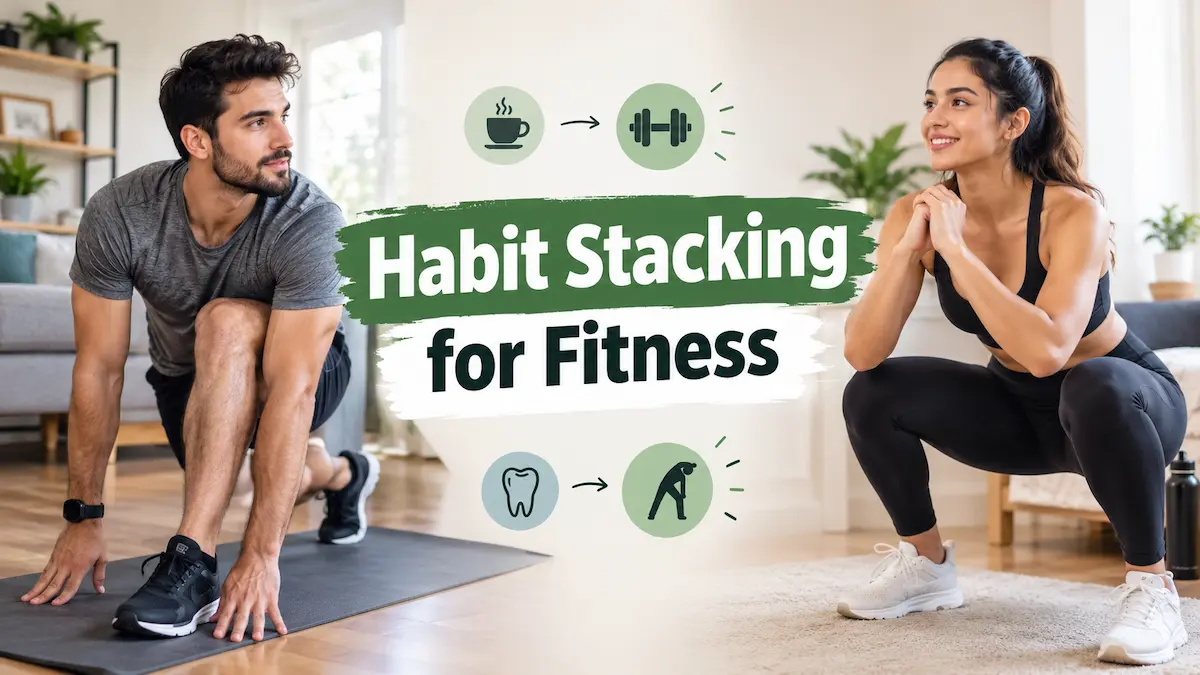
I have trained a lot of people who could push through a brutal workout without blinking, but could not show up consistently three times a week. And honestly, that’s the harder skill. Habit stacking for fitness is a simple way to turn everyday routines into consistent workout habits. Instead of relying on motivation or willpower, you connect a new fitness behavior to something you already do regularly.
The fix is not willpower. It’s design. And the simplest, most reliable tool I use with clients is something called habit stacking.
What Habit Stacking Actually Means
Habit stacking is simple: you attach a new behavior to an existing one you already do without thinking. Instead of trying to build a workout habit from nothing, you link it to something already wired into your day – brushing your teeth, making coffee, finishing a work call.
The logic behind this is not just convenience. Research on habit formation shows that habits form through repeated cue-behavior pairing – you do something in response to a consistent trigger enough times, and eventually your brain starts doing it with less and less conscious effort. A well-known UCL study tracking this process found that reaching near-automatic behavior took anywhere from 18 to 254 days, with a median around 66 days – far longer than the popular “21 days” myth, but also proof that it does happen if the cue stays consistent.
The existing habit is your cue. The new behavior is what you’re stacking on top of it.
How to Build Your Own Habit Stack

1. Pick an Anchor Habit You Do Consistently
This has to be something you do every single day without fail – making coffee, brushing your teeth, sitting down at your desk. The more consistent the anchor, the more consistent your new habit will become.
2. Attach a Tiny Version of the New Habit
Not the full 45-minute workout – a version so small it feels almost silly to skip. “After I make my morning coffee, I do 10 squats” is a far better starting stack than “after I wake up, I go to the gym for an hour.” You’re building the cue-response pathway first. Intensity comes later.
3. Keep the Stack in the Same Order Every Time
“After I finish my last work call of the day, I put on my shoes” works because the trigger is always the same. If your anchor habit happens at wildly different times, the cue becomes unreliable and the new habit struggles to stick.
4. Let the Stack Grow Naturally
Once the small version feels automatic – no internal negotiation, no talking yourself into it – you can extend it. Ten squats becomes a 5-minute routine. A 5-minute routine becomes 20 minutes. You’re not restarting the habit each time; you’re building on a foundation that already has some automaticity behind it.
Example Habit Stacks for Fitness
- After I pour my morning coffee – I do a 2-minute mobility routine
- After I close my laptop for lunch – I take a 10-minute walk
- After I brush my teeth at night – I do 20 bodyweight squats
- After I park my car at home – I change into workout clothes before going inside
- After my last meeting of the day – I do a 5-minute stretch at my desk
None of these require a gym, special equipment, or a huge time commitment. That’s intentional – the goal at the start is repetition, not intensity.
Why Most Fitness Habits Fail (And It’s Not Laziness)
In my experience, the biggest reason workout habits fail isn’t lack of discipline – it’s that people design the habit around motivation instead of around a cue. They plan to “work out in the morning” without tying it to anything specific, so on the days motivation dips, there’s nothing pulling them into action. A vague intention doesn’t survive a busy or tired day. If a busy schedule is what keeps disrupting your workouts, learn how to build exercise habits that survive a busy schedule. A specific stack – this trigger, then this action – does, because it doesn’t require you to remember or decide anything in the moment.
FAQ
Que.1 How long does it really take to build a fitness habit?
Ans. Research suggests it varies a lot person to person, with a median around two months for a behavior to start feeling automatic rather than effortful. Some people get there faster, some take longer – what matters more than the exact timeline is staying consistent with the same cue every day.
Que.2 What if I miss a day in my habit stack?
Ans. One missed day doesn’t undo your progress. Studies on habit formation have found that a single skipped instance doesn’t meaningfully damage the underlying habit-building process, as long as you get back to the routine soon after. The danger is in letting one missed day turn into a pattern of skipping.
Que.3 Can I stack more than one new habit onto the same anchor?
Ans. It’s better to stack one new habit at a time until it feels automatic, then add the next. Stacking too many new behaviors onto one cue at once usually overwhelms the process and none of them stick well.
Que.4 Does the anchor habit have to be fitness-related?
Ans. No, and often it should not be. The best anchors are habits you already do without fail, regardless of category – coffee, brushing your teeth, sitting at your desk. The connection to fitness only needs to exist in the new behavior you’re attaching.
Que.5 Is habit stacking better than just relying on motivation?
Ans. For long-term consistency, yes. Motivation is unreliable because it fluctuates with mood, stress, and energy. A well-built habit stack removes the need to feel motivated in the moment – the cue does the work of prompting the action.
Conclusion
You do not need more willpower to build a lasting fitness habit – you need a reliable trigger and a small enough starting action that skipping it feels harder than doing it. Pick one anchor habit you already do every day, attach a tiny version of the workout habit you want, and let it run for a few weeks before expanding it. Consistency with a small habit beats intensity with an inconsistent one, every single time.
This article is intended for general wellness and motivation purposes and is not a substitute for professional medical or psychological advice.