I get this question constantly: “Do I really need a gym membership to get stronger?” And I understand why people ask – there is this idea floating around that real strength only comes from a barbell and a rack of plates. It doesn’t. Your own bodyweight is resistance too, and when it’s used properly, it builds genuine strength, not just “toning.” The good news is that a no equipment home workout can build real strength when you use the right exercises and progressively make them more challenging.
There is solid research behind this, not just trainer opinion. A study comparing progressive bodyweight training to barbell squats in previously untrained women found that both methods produced significant improvements in strength and muscle growth. Another trial comparing bodyweight push-ups to barbell bench press training found meaningful upper-body strength gains in both groups. The common thread across this research is progressive overload – making the exercise harder over time – which you can absolutely do without a single piece of equipment.
Why Bodyweight Training Actually Works
The mistake people make is thinking bodyweight exercises are inherently “easier” than lifting weights. They’re not – they are just differently loaded. A single-leg squat, a slow push-up, or a plank with your feet elevated can challenge your muscles just as much as a moderately loaded barbell, especially if you are new to training. Your nervous system doesn’t know the difference between resistance from a dumbbell and resistance from your own body positioned in a way that makes gravity work harder against you.
For a broader look at how bodyweight movements fit into strength training, NPR also explains that exercises such as push-ups and squats count as resistance training
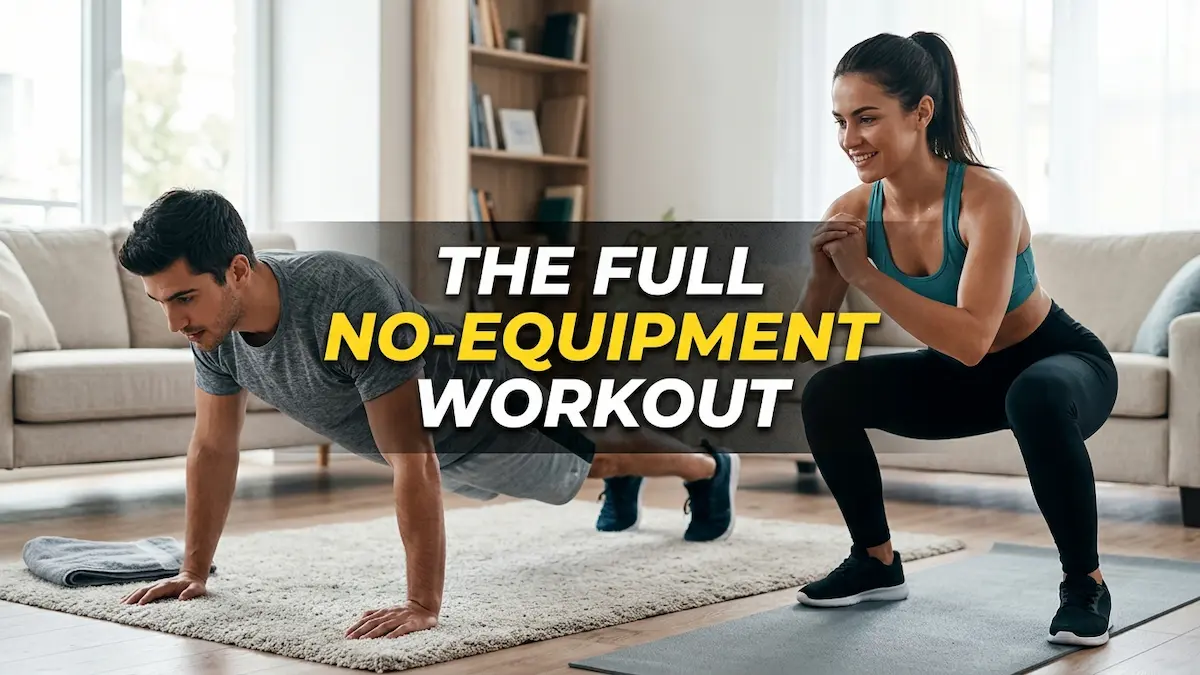
The Full No Equipment Home Workout
This is a complete routine I give clients who travel constantly or don’t have space for equipment at home. It hits your whole body in under 25 minutes.
1. Push-Ups (Chest, Shoulders, Triceps)
- Start in a plank position, hands slightly wider than shoulders.
- Lower your chest toward the floor, keeping your body in a straight line, then press back up.
- 3 sets of 8-15 reps.
Too hard? Drop to your knees. Too easy? Slow the lowering phase down to 3-4 seconds, or elevate your feet.
2. Bodyweight Squats (Quads, Glutes, Hamstrings)
- Feet shoulder-width apart, chest up.
- Lower down like sitting into a chair, thighs at least parallel to the floor, then drive back up.
- 3 sets of 12-20 reps.
For progression, try single-leg squats holding onto a chair for balance, or add a pause at the bottom of each rep.
3. Glute Bridges (Glutes, Hamstrings, Lower Back)
- Lie on your back, knees bent, feet flat on the floor.
- Drive your hips up toward the ceiling, squeezing your glutes at the top.
- 3 sets of 15 reps.
For more challenge, try single-leg glute bridges, alternating sides.
4. Plank Hold (Core)
- Forearms on the floor, elbows under shoulders, body in a straight line.
- Hold, keeping your core engaged and hips level.
- 3 sets, holding as long as possible with good form.
5. Reverse Lunges (Legs, Balance, Stability)
- Step one foot back, lowering into a lunge until both knees are around 90 degrees.
- Push back to standing, alternate legs.
- 3 sets of 10 reps per leg.
6. Superman Hold (Lower Back, Posterior Chain)
- Lie face down, arms extended in front of you.
- Lift your arms, chest, and legs slightly off the floor at the same time, squeezing through your lower back.
- Hold 2-3 seconds, lower, repeat.
- 3 sets of 10 reps.
Rest about 60-90 seconds between sets. If you’re pressed for time, cut rest to 30-45 seconds and treat the whole thing as a circuit.
How to Keep Progressing Without Adding Equipment
This is where most people get stuck – they do the same version of a push-up or squat for months and wonder why progress stalls. If you eventually want to add a few practical tools to your home setup, see our guide to The Minimalist’s Desk-Fitness Setup: What’s Worth Buying. The fix isn’t buying dumbbells, it’s manipulating the exercise itself:
- Slow the tempo down. A 4-second lowering phase on a push-up or squat is dramatically harder than a fast rep, even though the movement looks identical.
- Change the leverage. Elevating your feet during push-ups, or moving to a single-leg version of a squat, increases the load your muscles have to handle.
- Add pauses. A 2-3 second pause at the hardest point of a rep removes momentum and forces your muscles to do all the work.
- Increase the range of motion. Deeper squats, fuller push-ups, and a longer plank hold all raise the difficulty without needing a single extra tool.
FAQ
Que1. Can I actually build muscle with just bodyweight exercises?
Ans. Yes. Research on bodyweight training has shown meaningful improvements in strength and hypertrophy, particularly in people who are new to structured training. Progressive overload – making the exercise harder over time through tempo, leverage, or range of motion — is what drives the results, not necessarily external weight.
Que2. Is bodyweight training enough for advanced lifters?
Ans. It can take you fairly far, but very advanced strength athletes eventually benefit from external load for precise, continued progression. For most people focused on general strength, mobility, and fitness, bodyweight training alone is more than enough for a long time.
Que3. How often should I do a no equipment home workout like this?
Ans. Three to four times a week works well for most people, with at least one rest or lighter day between sessions to allow muscles to recover.
Que4. Do I need a mat or any equipment at all?
Ans. Not strictly, though a yoga mat or towel makes floor exercises like planks and glute bridges more comfortable. Everything in this routine can be done on a bare floor or carpet if that’s what you have.
Que5. Is bodyweight training good for beginners?
Ans. It’s actually one of the best starting points, since it builds coordination, balance, and baseline strength without the technical learning curve of barbells or machines. Many trainers, myself included, start almost every new client on bodyweight movements before introducing external load.
Conclusion
You don’t need a gym membership, a garage full of equipment, or even a single dumbbell to get genuinely stronger. What you need is a well-structured routine and a way to keep making it harder over time – both of which this workout gives you. Start with two to three sessions a week, focus on slowing down your reps and improving your range of motion before you worry about adding complexity, and you’ll be surprised how far bodyweight training alone can take you.
This article is intended for general fitness purposes and isn’t a substitute for professional medical advice. If you have an existing injury or health condition, consult a doctor or physical therapist before starting a new exercise routine.