Most people do not fail at fitness because they are lazy. They fail because the first step is too big. A gym membership, a 45-minute routine, new shoes, a whole new schedule. By the time you have planned all that, you are already tired.
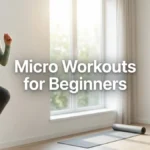
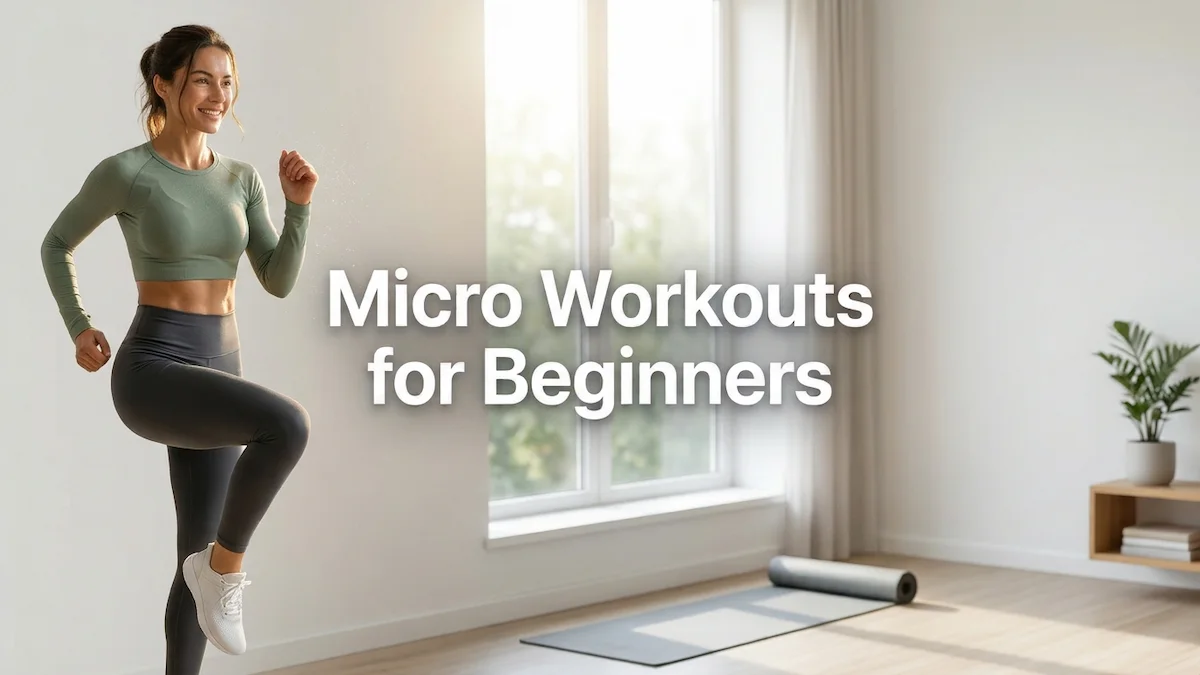
That’s exactly why micro workouts for beginners make so much sense. A micro workout is a short burst of exercise, usually one to five minutes, that you can do almost anywhere, in normal clothes, with no equipment and no plan bigger than do this now. If you have been putting off exercise because you don’t know where to begin, this is a version of beginning that’s hard to mess up.
Below you will find what a micro workout actually is, what the research says (and does not say), five easy moves, and a four-week plan that goes slowly on purpose.
What Is a micro workouts for beginners, Exactly?
Think of it as a small dose of movement instead of one big meal. Instead of “I will work out for an hour on Saturday,” you do a minute or two of sit-to-stands after breakfast, a short march while the kettle boils, a few wall push-ups in the evening.
Researchers sometimes call this exercise snacking: short, spread-out bouts of activity during the day. If you want more background on the idea, I’ve covered it in Micro Workouts: How 2-Minute Exercise Bursts Can Replace Your Gym Session. This article is the beginner’s on-ramp.
Do Short Bursts Actually Count? What the Research Says
Fair question, because two minutes of exercise sounds too small to matter. Here’s the honest picture.
The World Health Organization recommends 150 to 300 minutes of moderate to vigorous activity a week for adults. But its guidance also carries an encouraging message: WHO’s Dr. Ruediger Krech said that activity of any type and any duration can improve health and wellbeing, though more is always better. So the short stuff is not pointless. It just isn’t the finish line.
There’s also a large study that got a lot of attention. Researchers at the University of Sydney used wrist trackers to follow more than 25,000 people who reported no exercise in their free time. People who squeezed in a few very short bursts of vigorous effort during daily life, like hurrying up stairs or power walking, with most bursts lasting a minute or less, had a lower risk of death over the following seven years. Three to four one-minute bursts a day were linked with notably lower risk.
Now the caution. That study is observational. It shows an association, not proof that the bursts caused the benefit. And when other researchers reviewed the studies on exercise snacks, they concluded the approach looks feasible and safe, but the trial evidence on health effects is still limited and mixed.
My honest read: micro workouts are a solid way to start moving and build a habit, not a magic shortcut. For a beginner, that’s exactly what you need.
One important distinction: the Sydney study focused on brief bursts of vigorous everyday activity, not gentle beginner exercises like wall push-ups or slow marching. So, while the findings are encouraging, they should not be taken as proof that every one-minute movement produces the same benefits. The takeaway is simple: even small amounts of movement matter, and beginners can build up gradually.
Why Micro Workouts Work So Well for Beginners
- They remove the I don’t have time excuse. Two minutes fits into any day.
- They lower the fear factor. Nobody feels intimidated doing a few wall push-ups at home.
- They go easy on your body. Starting small gives your muscles, joints, and tendons time to adapt.
- They build the habit before the fitness. Showing up consistently matters more, early on, than how hard you work.
That last point is the heart of it. If you have ever started a big plan and quit in week two, the problem probably was not your willpower. The plan was too heavy to survive a bad day. A small one survives.
5 Easy Micro Workouts to Start With
None of these need equipment. Move at a pace where you could still talk in short sentences. If something hurts (not “this is hard,” but actual pain), stop.
1. Sit-to-Stand (30-60 seconds)
Sit on a sturdy chair, stand up fully, sit back down slowly. Repeat. It’s a squat in disguise and a great leg starter. Use your arms for help at first if you need to.
2. Wall Push-Ups (30-60 seconds)
Stand an arm’s length from a wall, hands on it at shoulder height. Bend your elbows to bring your chest toward the wall, then push back. Easier than floor push-ups, and still real work for your chest, shoulders, and arms.
3. March in Place (1-2 minutes)
Lift your knees, swing your arms, keep a steady beat. It warms you up and gently raises your heart rate. A good one to do while waiting for tea or coffee.
4. Glute Bridge (30-60 seconds)
Lie on your back, knees bent, feet flat. Press your hips up, squeeze your glutes at the top, lower slowly. Especially useful if you sit a lot.
5. Standing Calf Raises (30-60 seconds)
Hold a counter for balance, rise onto your toes, lower slowly. Simple, low-impact, and easy on the joints.
Your First 4 Weeks: A Plan That Goes Slowly on Purpose
Here’s a gentle progression. Don’t skip ahead just because it feels easy. Easy is the point.
| Week | What to do | How often |
| Week 1 | Pick ONE move from the list. Do it for 1 minute. | Once a day |
| Week 2 | Same move, or add a second, for 1-2 minutes total. | Once or twice a day |
| Week 3 | Mix 2-3 different moves, about 2-3 minutes total. | Twice a day |
| Week 4 | A 3-5 minute mini circuit of your favourite moves. | Twice a day, most days |
A few rules that keep this from falling apart:
- Tie it to something you already do. After brushing your teeth, after the first coffee, when the microwave starts. I explain the method in Habit Stacking for Fitness: How to Build Workout Habits That Actually Stick.
- On a bad day, shrink it, don’t skip it. Ten reps still counts. That’s the logic behind The 2-Minute Rule: How to Start Any Habit Without Overwhelm.
- Want a ready-made routine? Once week 4 feels comfortable, try The 5-Minute Morning Micro Workout to Wake Up Your Whole Body.
Common Beginner Mistakes (and Easy Fixes)
Doing too much, too soon. If you’re sore for four days, you went too hard. Back off a little.
Waiting until you “feel like it.” You often won’t. Start the two minutes and let the motivation catch up.
Judging it by the scale. Micro workouts won’t change your weight quickly, and that’s fine. Watch for easier stairs, better energy, and less stiffness instead.
Giving up after one missed day. One miss means nothing. Just try not to miss twice in a row.
When to Check With a Doctor First
If you have a heart condition, high blood pressure, joint problems, are pregnant, or haven’t been active for a long time and have health concerns, talk to your doctor before starting. Stop and seek medical advice if you feel chest pain, dizziness, or unusual shortness of breath.
FAQ
Que.1 Are micro workouts enough to get fit?
Ans. They’re enough to start, and the research suggests short bursts can contribute to health benefits. But for major strength or endurance gains, you’ll eventually want longer or harder sessions. Think of micro workouts as the first rung of the ladder, not the whole ladder.
Que.2 How many micro workouts should a beginner do per day?
Ans. One to three is plenty at the start. Consistency matters far more than the number.
Que.3 Can I lose weight with micro workouts?
Ans. They add to your daily movement, which helps, but weight depends mostly on your overall eating and total activity. Treat micro workouts as one useful piece, not the whole plan.
Que.4 What’s the best time of day to do them?
Ans. Whenever you’ll actually do them. Many beginners like the morning, after meals, or during work breaks.
Que.5 Do I need to warm up for a one-minute workout?
Ans. For gentle moves like these, a few easy movements are enough. Marching in place for 30 seconds works as a warm-up.
Que.6 What if I feel silly exercising at work?
Ans. Choose the discreet ones: sit-to-stands, calf raises, and standing marches. Or use a stairwell, a hallway, or the break room.
Conclusion
You don’t need to overhaul your life to start exercising. You need one tiny move, one fixed moment in your day, and the patience to let it grow slowly. Pick a single exercise from the list, do it for a minute tomorrow, and repeat. That’s the whole plan for week one. Everything else can wait.
This article is for general wellness information and isn’t a substitute for professional medical advice. Consult a doctor before starting a new exercise routine, especially if you have a health condition.
References
- World Health Organization (WHO). WHO Guidelines on Physical Activity and Sedentary Behaviour (2020).
- Stamatakis et al. Association of wearable device-measured vigorous intermittent lifestyle physical activity with mortality. Nature Medicine (2022).
- Exercise snacks and other forms of intermittent physical activity for improving health in adults and older adults: A scoping review. PubMed (2024).
- Pan American Health Organization (PAHO). Every move counts towards better health, says WHO (2020).