I just don’t have time to work out – I have probably heard this line more than any other sentence in my years of training people. And honestly, for a lot of busy professionals, it is true. Between meetings, deadlines, and everything else pulling at your day, blocking out an hour for the gym can feel impossible.
Here is what changed how I coach people around this problem: you don’t actually need that hour. Research on something called “exercise snacking” – short, intentional bursts of movement spread across your day – has shown real, measurable benefits, even when the total time adds up to just a few minutes. Research on short bursts of physical activity suggests that even brief periods of vigorous movement may be associated with meaningful health benefits, particularly when they are repeated consistently throughout the day. Recent reviews suggest that exercise snacks may improve cardiorespiratory fitness and may also benefit markers such as blood glucose and blood pressure, although the strength of evidence varies by outcome and study design.
That’s the real advantage of micro workouts. Not that they replace a full training program, but that they replace nothing – which, for most people, is what is actually happening right now.
What Counts as a Micro Workout
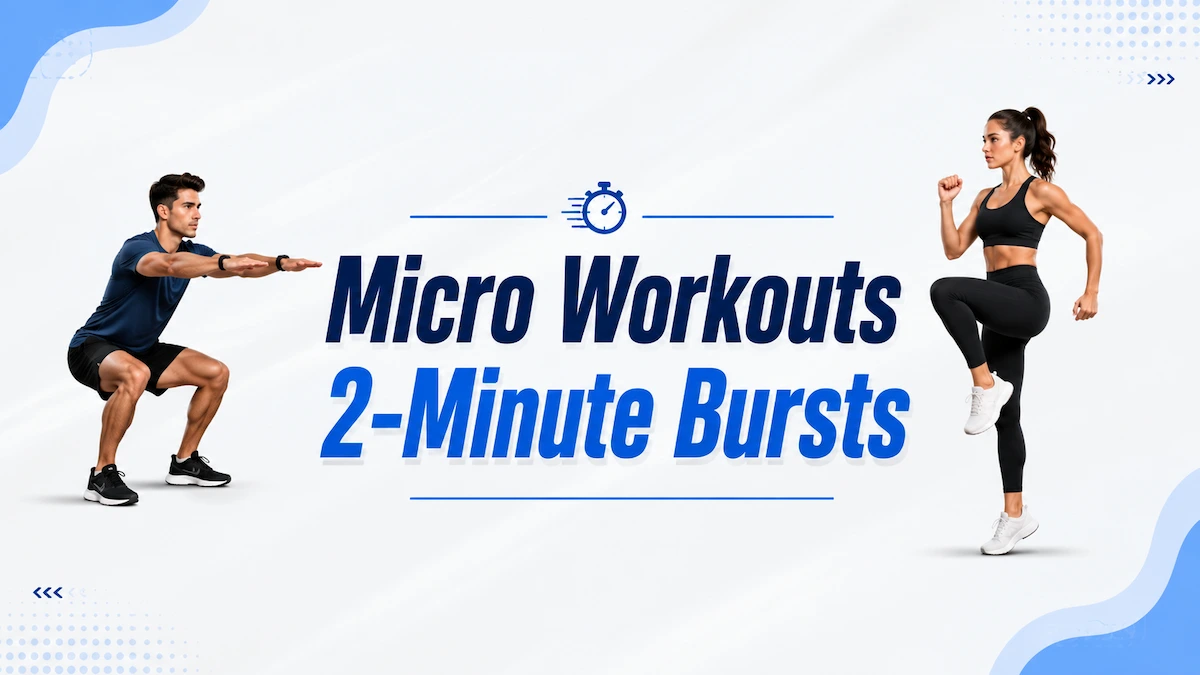
A micro workout is any short, focused burst of physical activity – usually one to five minutes – done with enough intensity to genuinely challenge your body. It is not a leisurely stretch. Think fast bodyweight squats, a brisk set of stairs, or push-ups done right at your desk. The idea is to get your heart rate up and your muscles working, then get straight back to your day.
5 Micro Workouts You Can Do Right Now
1. The Desk Squat Burst (60 seconds)
- Stand up from your chair, feet shoulder-width apart.
- Do bodyweight squats as fast as you comfortably can, using good form, for 45-60 seconds.
- Rest, sit back down, get back to work.
This alone gets your heart rate up and works your entire lower body – no equipment needed.
2. Wall or Desk Push-Up Set (60-90 seconds)
- Place your hands on your desk edge (or a wall for an easier version), walk your feet back until your body forms a straight line.
- Do as many push-ups as you can with good form for 60-90 seconds.
If you are stronger, drop to the floor for standard push-ups. This is one of the fastest ways to hit your chest, shoulders, and arms in under two minutes.
3. Stair Sprint (1-2 minutes)
- If you have access to a staircase, walk or jog up briskly, then walk back down slowly to recover.
- Repeat for 1-2 minutes total.
Stair climbing is one of the most efficient forms of exercise snacking there is – a couple of short flights done a few times a day adds up to real cardiovascular benefit.
4. Standing Marching with High Knees (60 seconds)
- Stand tall and march in place, driving your knees up toward your chest as high as you comfortably can.
- Keep a quick pace for 45-60 seconds.
This is a great option if you’re in a small space or working from home without room for bigger movements.
5. Plank Hold (30-60 seconds)
- Get into a forearm plank position, elbows under shoulders, body in a straight line.
- Hold for as long as you can with good form, up to 60 seconds.
A single solid plank hold engages your entire core, and it’s one of the few micro workouts you can do virtually anywhere, including a hotel room or a quiet corner of the office.
How to Actually Build This Into Your Day
The mistake most people make is trying to schedule micro workouts like a formal training block. That defeats the purpose. Instead, attach them to things you already do:
- One burst right after your morning coffee, before you open your laptop
- One burst before lunch, as a natural transition point
- One burst in the late afternoon, when energy usually dips
Three short bursts a day, done consistently, beats a single ambitious hour-long workout that you skip half the time because you’re too busy or too tired.
Still wondering whether a few short bursts can really compare with a traditional gym session? Our guide to Micro-Workouts vs. One Gym Session: Which Actually Works Better? breaks down the pros, limitations, and best use cases for both approaches.
FAQ
Que1. Can micro workouts actually replace a full workout routine?
Ans. Not completely. Micro workouts can provide meaningful health and fitness benefits, especially for people who struggle to fit traditional exercise into their schedule. However, they don’t necessarily replace a structured workout program when your goals include significant muscle growth, strength development, or sport-specific performance.
Que2. How many micro workouts should I do per day?
Ans. Most research on exercise snacking looks at two to four short bouts per day, spaced a few hours apart. Even one or two bouts consistently done is better than none, so start with what realistically fits your schedule.
Que3. Do micro workouts help with weight loss?
Ans. They contribute to your overall daily energy expenditure and help offset long periods of sitting, but weight loss depends primarily on overall diet and total activity. Think of micro workouts as one useful piece of the puzzle, not a stand-alone weight-loss plan.
Que4. Are micro workouts safe for beginners?
Ans. Generally yes, since the bouts are short and can be scaled to your fitness level – a beginner might do a 30-second version of what an advanced person does for 90 seconds. If you have any existing health conditions, it’s worth checking with a doctor before starting any new activity, including short bursts of vigorous exercise.
Que5. What if I don’t have any privacy at work to do these?
Ans. Some of these, like desk squats or standing marches, are subtle enough to do at your desk. Others, like push-ups or planks, work better in a break room, stairwell, or even a quick trip to your car. Even a brisk two-minute walk counts as a lighter version of exercise snacking if intensity isn’t an option in your space.
Conclusion
You don’t need an hour at the gym to start seeing real benefits from movement – you need consistency, and consistency is a lot easier to build with two-minute bursts than with hour-long sessions you keep postponing. Pick two or three of these micro workouts, attach them to moments you already have in your day, and give it two weeks. Most people are surprised at how much more energy and how much less stiffness they feel, without ever having to “find time” for exercise in the traditional sense.
This article is intended for general wellness purposes and isn’t a substitute for professional medical advice. If you have an existing health condition, consult a doctor before starting any new exercise routine.