Walk into any home gym setup video online and you will see a squat rack, a barbell, a cable machine, a bench, and about forty other things that cost more than a used car. It looks impressive. It’s also the reason a lot of people never start. They think a home gym needs a spare room and a big budget.
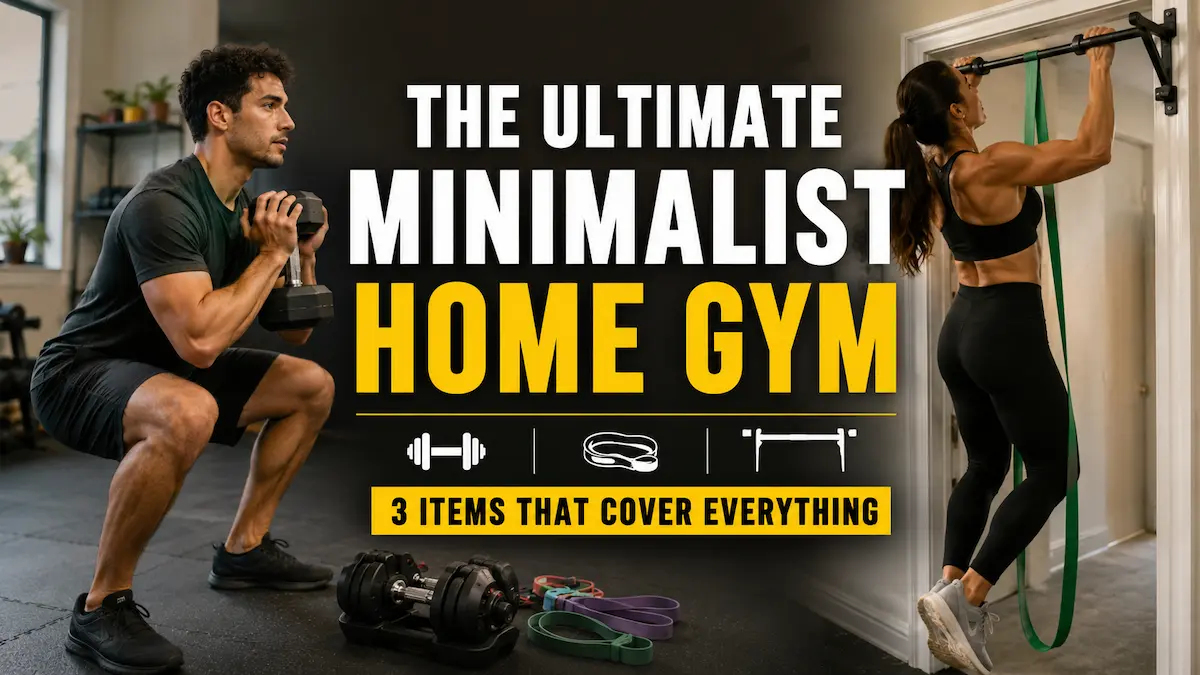
A minimalist home gym makes it easier to build strength, train your entire body, and stay consistent without spending money on bulky equipment.
It does not. After years of training people in small apartments, shared rooms, and hotel stays, I can tell you that three well-chosen items cover almost everything most people need: pushing, pulling, legs, core, and a bit of cardio.
Here’s the setup, why each piece earns its place, and how to use them together.
The Rule for Building a Minimalist Home Gym
Before I recommend anything, it has to pass three questions:
- Can it train more than one muscle group? One-trick equipment does not make the cut.
- Can you make it harder as you get stronger? If you outgrow it in six weeks, it’s a waste.
- Does it fit in a cupboard or behind a door? If it needs its own room, it’s not minimal.
Three items pass all three.
Item 1: Adjustable Dumbbells
If I could keep only one thing, this would be it.
A single adjustable pair replaces a whole rack of fixed weights, and it takes up about the floor space of a shoebox. You can use it for goblet squats, lunges, Romanian deadlifts, shoulder presses, rows, curls, chest presses on the floor, and loaded carries.
Why it earns its place: it solves the biggest problem with bodyweight training, which is progression. Once push-ups and squats get easy, you need a way to add load in small steps. Dumbbells do that.
What to look for:
- A range that suits you now and leaves room to grow. Beginners often start lighter than they expect, and that’s fine.
- A quick, secure adjustment system. If changing weights is annoying, you will skip changes.
- A stable base when you set them down.
Honest tip: a single kettlebell also works well in this slot, especially for swings and carries. I lean toward dumbbells for beginners because the movements are easier to learn and scale.
Item 2: Resistance Bands
Bands are the most underrated piece of home equipment. They weigh almost nothing, cost very little, and fit in a drawer or a backpack.
What they do best:
- Add resistance to movements dumbbells can not load well, like pull-aparts, face pulls, and lateral walks.
- Make pulling exercises possible when you do not have a pull-up bar yet (rows, lat pulldowns anchored to a door).
- Assist pull-ups and push-ups, or add tension to them, depending on how you use them.
- Warm up shoulders and hips before training.
- Travel with you. They are the reason I never skip training in a hotel.
Do they actually work? Yes. A systematic review and meta-analysis comparing elastic resistance training with conventional resistance training (weight machines and free weights) found no superiority of either method for strength gains, in both upper and lower limbs. The pooled data came from around 224 participants across seven studies, per the authors’ 2020 correction. In plain words: bands can build strength about as well as traditional weights in the studies reviewed. One honest limit: that review looked at strength, not muscle size, and the number of studies was small.
What to look for: a set of loop bands in a few resistance levels, plus a set with handles and a door anchor. That combination covers most exercises.
Item 3: A Doorway Pull-Up Bar
This is the piece that rounds out the setup, because it gives you a vertical pull, and that’s the one movement that’s hard to replicate with anything else.
Pull-ups and chin-ups train your lats, upper back, biceps, and grip. They are also a solid test of relative strength. And a pull-up bar is the only item on this list that gives you a true bodyweight pulling exercise.
Start where you are:
- Can’t do a pull-up yet? Use a band for assistance, or do slow negatives (jump up, lower yourself over 4-5 seconds).
- Doing pull-ups easily? Slow the tempo, add pauses, or hang a light weight from a backpack.
- You can also use the bar for hanging knee raises, which are great for core strength.
Safety note: doorway bars rely on your door frame. Check that your frame is solid and the bar is rated for your weight, and follow the manufacturer’s instructions. If your door frame feels flimsy, go for a wall-mounted or freestanding option instead.
How a Minimalist Home Gym Trains Your Whole Body
| Movement | What you do | Tool |
| Squat | Goblet squats, split squats | Dumbbells |
| Hinge | Romanian deadlifts, glute bridges with load | Dumbbells |
| Push | Push-ups (loaded or banded), overhead press | Dumbbells, bands |
| Vertical pull | Pull-ups, chin-ups | Pull-up bar, bands for assistance |
| Horizontal pull | Rows, band pull-aparts | Dumbbells, bands |
| Core | Hanging knee raises, plank variations | Pull-up bar, bodyweight |
| Warm-up & mobility | Shoulder and hip band work | Bands |
That’s every major movement pattern. Not bad for three things you can store behind a door.
A Simple Weekly Plan Using Just These Three
This is a basic starting template. Adjust sets and reps to what you can do with good form.
Day 1: Lower body + core
- Goblet squats: 3 x 10-12
- Romanian deadlifts: 3 x 10-12
- Reverse lunges: 3 x 10 per leg
- Hanging knee raises or planks: 3 sets
Day 2: Rest or easy walk
Day 3: Upper body
- Pull-ups (or band-assisted): 3 sets
- Dumbbell floor press or push-ups: 3 x 8-12
- One-arm dumbbell rows: 3 x 10 per side
- Band pull-aparts: 3 x 15
Day 4: Rest or easy walk
Day 5: Full body
- Dumbbell thrusters or squat-to-press: 3 x 10
- Band rows: 3 x 12
- Push-ups: 3 sets near your limit
- Glute bridges: 3 x 15
Rest 60-90 seconds between sets. When every set feels comfortable at the top of your rep range, move up in weight or slow the tempo.
What You Don’t Need (Yet)
A bench, a barbell, a squat rack, a treadmill, a cable machine. They’re all useful, and none of them are needed to build a strong, capable body at home. Add something only when you can name the specific thing it lets you do that your current gear can’t. For a closer look at training with no gear at all, see No-Equipment Home Workout: Build Real Strength With Just Your Bodyweight.
FAQ
Que.1 Can I build muscle with just these three items?
Ans. Yes, especially if you’re a beginner or intermediate. Muscle growth needs enough challenge over time, and you can create that by adding load, slowing your reps, or increasing reps and sets. Very advanced lifters eventually benefit from heavier or more varied equipment.
Que.2 Which of the three should I buy first?
Ans. Adjustable dumbbells give you the most range on day one. If your budget is tight, start with resistance bands and bodyweight training, then add dumbbells and a pull-up bar over time.
Que.3 Are resistance bands as good as weights?
Ans. A meta-analysis of strength outcomes found no superiority between elastic and conventional resistance training, so bands can be a legitimate way to build strength. They’re less precise for tracking exact load, which is why I pair them with dumbbells.
Que.4 Is a doorway pull-up bar safe?
Ans. It can be, if your door frame is sturdy and the bar is installed as the maker instructs. Don’t swing wildly or kip on a doorway bar, and if you have any doubts about your frame, choose a different mounting option.
Que.5 How much space do I need?
Ans. About the width of a yoga mat plus room to extend your arms. If you can lie down and stretch your arms overhead without hitting furniture, you have enough.
Que.6 What about cardio?
Ans. Dumbbell complexes, band circuits, and fast bodyweight rounds raise your heart rate quickly. Walking, stairs, or a run outside work well alongside this setup. You can add a jump rope later if you want.
Que.7 I’m a complete beginner. Is this still the right setup?
Ans. Yes. Start light, keep the movements simple, and focus on form for the first few weeks. The setup doesn’t change as you progress, only the load and difficulty.
Conclusion
A good home gym isn’t about how much you own. It’s about whether you’ll actually use it. Three pieces of gear, adjustable dumbbells, resistance bands, and a pull-up bar, cover pushing, pulling, legs, and core, and they fit almost anywhere. Pick the one you can start with this week, build a simple routine around it, and add the others as you go. Consistency will do more for you than any amount of equipment.
This article is intended for general fitness purposes and isn’t a substitute for professional medical advice. If you have an injury or health condition, consult a doctor or physical therapist before starting a new exercise routine.