
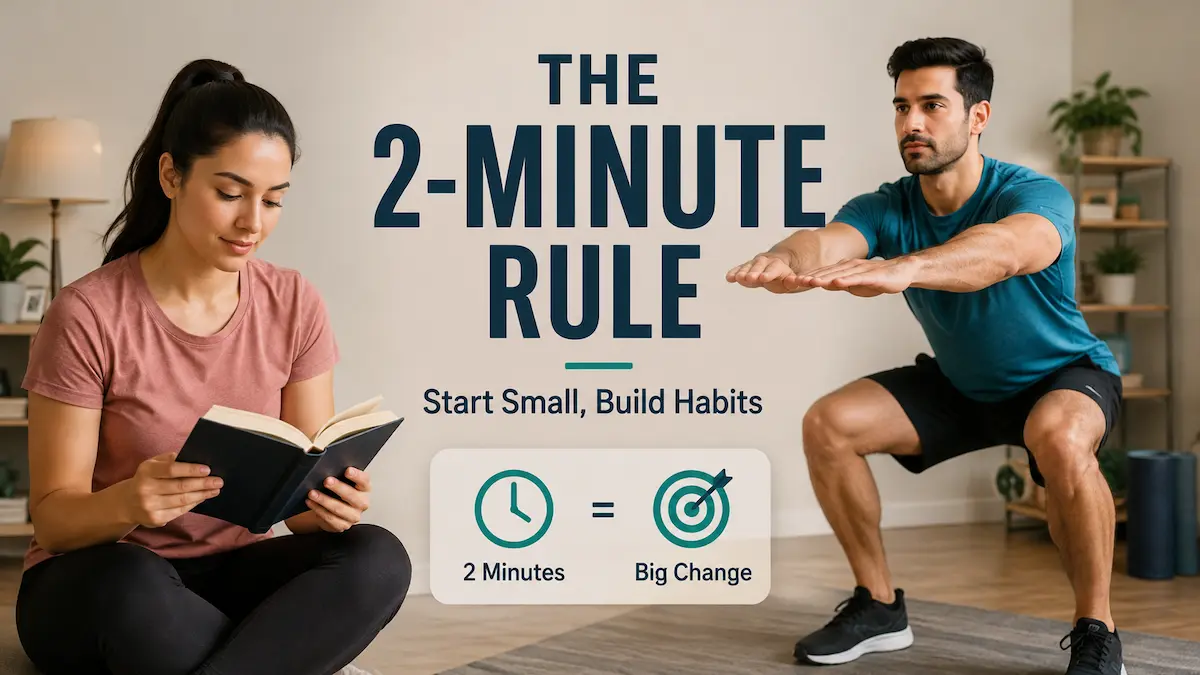
Let me describe a scene I’ve watched play out dozens of times with new clients. It’s January (or a Monday, or the day after a bad weekend), and they walk in with a plan that sounds incredible on paper: gym five days a week, meal prep on Sundays, no sugar, eight hours of sleep, ten minutes of meditation. They’re fired up.
By week two, almost all of it is gone.
It’s not because they’re lazy. It’s because they tried to build five habits at the size of a full-time job. The plan was too big to survive a bad day, and every bad day makes a big plan feel heavier.
One simple way to make starting easier is the 2-minute rule.
What Is the 2-Minute Rule?
The idea is this: when you start a new habit, scale it down until it takes two minutes or less.
- “Read before bed” becomes “read one page.”
- “Run three times a week” becomes “put on my running shoes.”
- “Do a 45-minute workout” becomes “do 10 squats.”
- “Meditate for 20 minutes” becomes “take three slow breaths.”
The 2-minute rule was popularized by James Clear in Atomic Habits. It is a practical strategy for making new habits easier to start, rather than a scientifically established rule that guarantees success. Research on habit formation and action planning offers useful support for some of the principles behind it.
Why It Works (And Why Starting Small Isn’t “Cheating”)
The most common pushback I hear is, “Ten squats won’t change my body. What’s the point?”
And they’re right. Ten squats won’t. That’s not what they’re for.
In the first few weeks, you’re not building fitness. You’re building the behavior of showing up. A habit is basically your brain learning “when this happens, I do that.” Research from University College London helps explain why repetition matters. In a 2010 study, researchers followed 96 volunteers who chose a daily eating, drinking, or activity behavior to practice in a consistent context. Among the participants whose data could be modeled, the time needed to reach 95% of their estimated automaticity plateau ranged from 18 to 254 days. The often-cited median is around 66 days, but the findings show that habit formation varies considerably from person to person. Repeating a behavior in a consistent context was associated with increasing automaticity.
A two-minute version can make repetition easier to maintain. Even when motivation is low, a small action may feel more manageable than a full workout or a longer reading session. The aim is to reduce the effort needed to get started and make consistent practice easier.
As the behavior becomes more familiar, you may find it easier to increase the duration or intensity gradually. Starting is often a major challenge, and the 2-minute rule is designed to make that first step feel more manageable.
There’s Real Research Behind the “Make It Specific” Part
Here’s the second half of the trick, and it’s what separates people who succeed from people who just “try to remember.”
Don’t just say “I’ll do my two minutes sometime today.” Attach it to a specific cue: “After I pour my morning coffee, I will do 10 squats.”
Psychologists call this an implementation intention, basically an if-then plan. A well-known meta-analysis by Gollwitzer and Sheeran, covering 94 independent studies, found that forming these if-then plans had a medium-to-large effect on goal attainment (an effect size of about 0.65). In plain words: people who decided when and where they’d act followed through far more often than people who only had the goal.
So the formula I teach is:
After [existing habit], I will [2-minute version of new habit].
Simple. Specific. Hard to forget.
How to Use the 2-Minute Rule: Step by Step
Step 1: Pick ONE Habit
Just one. I know that feels slow. It isn’t. Stacking five new habits at once is exactly how people end up with zero habits by February.
Step 2: Shrink It Until It’s Almost Silly
If you hesitate for even a second when you read it, it’s still too big. “Do a full workout” becomes “do one set of push-ups.” “Eat healthier” becomes “add one vegetable to lunch.” If it makes you think, that’s too easy to count, you’ve got the size right.
Step 3: Attach It to a Cue You Already Have
Pick something you do every single day without fail: brushing your teeth, making coffee, sitting down at your desk, plugging in your phone at night. That’s your anchor. If you want to go deeper on this part, I walk through the whole system in Habit Stacking for Fitness: How to Build Workout Habits That Actually Stick.
Step 4: Do It Even on Terrible Days
On difficult days, try to keep the habit small and manageable. You don’t need to complete a full workout or a long reading session to practice consistency. If you’re tired, unwell, or need rest, it’s okay to pause and return when you’re ready. The goal is to build a sustainable routine, not to maintain a perfect streak at all costs.
Step 5: Let It Grow Naturally, Not by Force
Over time, you may feel ready to do more once you’ve started. Ten squats might become two sets, or one page might turn into a chapter. Increase the duration gradually when it feels manageable, rather than forcing yourself to progress on a fixed schedule. If you continue with the two-minute version for a while, that’s okay too. You can adjust the habit as your routine develops.
Examples You Can Steal Today
| Big goal | 2-minute version | Cue |
| Work out regularly | Do 10 bodyweight squats | After I make my morning coffee |
| Stretch more | One 60-second hip stretch | After I close my laptop for the day |
| Drink more water | Drink one glass | After I wake up |
| Walk daily | Walk to the end of the street and back | After lunch |
| Sleep better | Put my phone on the charger across the room | After I brush my teeth |
| Be consistent when life gets busy | Do the smallest possible version | See Build Exercise Habits That Survive a Busy Schedule |
The Mistakes I See Most Often
1. Making the “2-minute” version actually 20 minutes. If you catch yourself saying “well, since I’m already here…”, that’s fine as a bonus. But the requirement must stay at two minutes, or the habit gets heavy again.
2. Skipping because “it’s too small to matter.” This is the trap. The size isn’t the point. The repetition is.
3. Changing the cue constantly. If you do your two minutes after coffee one day, after lunch the next, and “whenever” on the third, your brain never learns the trigger. Keep the cue fixed.
4. Missing a day and giving up completely. One missed day doesn’t erase your progress. Instead of worrying about an unbroken streak, return to your habit at the next planned opportunity. Consistency over time matters more than perfection.
FAQ
Que.1 Does the 2-minute rule really work for fitness?
Ans. Yes, as a starting tool. It won’t build serious strength or endurance by itself, since two minutes of exercise is a foundation rather than a full program. But it gets you moving consistently, and consistency is the thing most people fail at long before they hit any physical limit.
Que.2 How long should I stay at the 2-minute stage?
Ans. There’s no fixed timeline. Stay with the two-minute version until it feels manageable and fits comfortably into your routine. You can then increase it gradually if you want to. Research suggests that habit formation varies widely between individuals, so there’s no need to rush the process.
Que.3 What if two minutes still feels like too much?
Ans. Then shrink it further. “Put on my workout clothes” or “open my workout app” is a legitimate first step. The goal is to make the starting action so easy that resistance has nothing to push against.
Que.4 Can I use the 2-minute rule for breaking bad habits?
Ans. It’s built for starting good habits, not quitting bad ones. For bad habits, a better approach is usually to make the bad behavior harder to do and replace it with a small alternative.
Que.5 What if I forget to do my 2-minute habit?
Ans. That usually means the cue isn’t strong enough. Switch your anchor to something you literally never skip, like brushing your teeth, and put a visible reminder where you’ll see it, such as your yoga mat by the bed or your shoes by the door.
Que.6 Is this just for beginners?
Ans. Not at all. Experienced lifters and athletes use it too, especially when restarting after injury, travel, or a long break. Whenever motivation is low, the two-minute version keeps the thread from breaking.
Conclusion
You don’t need more motivation to build a lasting habit. You need a version of the habit that’s small enough to do on your worst day, and a specific cue that tells you when to do it. Pick one habit today. Shrink it to two minutes. Attach it to something you already do. Then protect that streak like it matters, because the person you’re becoming depends on it.
Start tomorrow morning, and keep it ridiculously small.
This article is intended for general wellness and motivation purposes and isn’t a substitute for professional medical or psychological advice.