
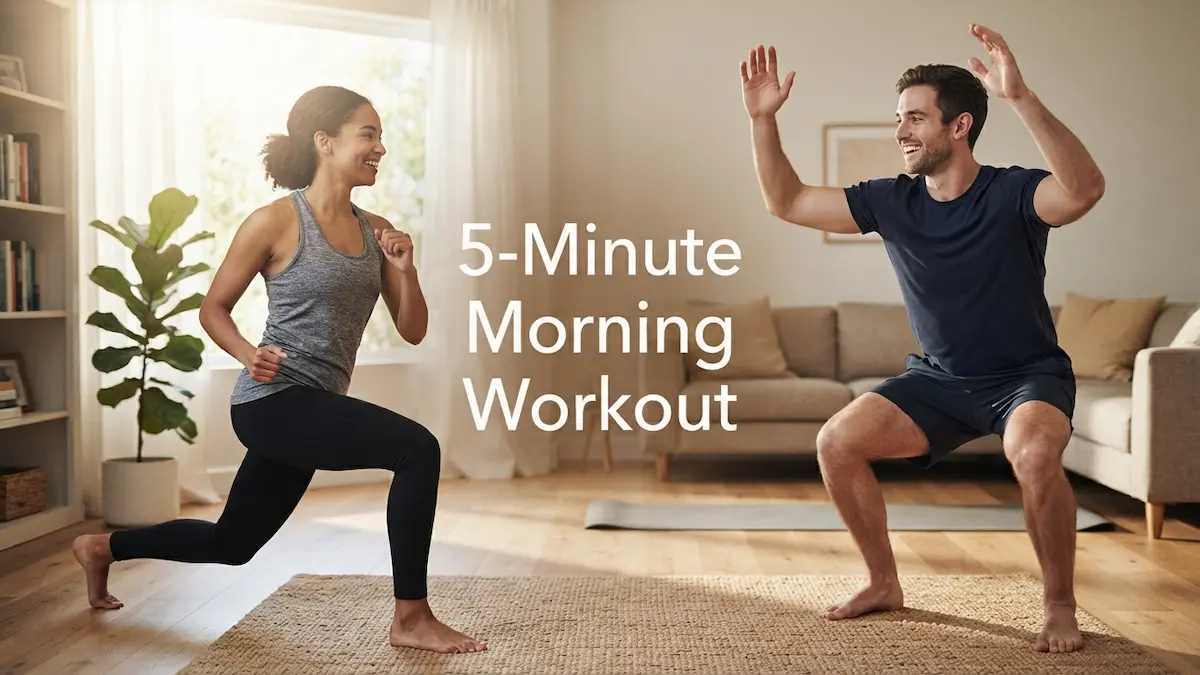
There is a specific kind of grogginess that coffee alone does not fix – that heavy, half-asleep feeling in your muscles even after you are technically “awake.” I used to think more caffeine was the answer. It was not. What actually snapped me out of that fog was ridiculously simple: five minutes of movement before I even opened my laptop.
Here is why this works better than it sounds. Your body does not fully wake up just because your eyes are open – your nervous system, circulation, and muscles need a signal to switch from “rest mode” to “go mode.” Movement is that signal. Research shows that physical activity can provide immediate benefits, including helping you feel better and function better, while the best time of day to exercise can vary from person to person. Getting your body moving early can also help you feel more ready to take on the day’s demands. You don’t need 45 minutes on a treadmill to get moving – even five focused minutes can be a simple way to start the day feeling more alert.
Why Five Minutes Is the Sweet Spot
The reason most people skip morning workouts is not laziness – it’s that “workout” sounds like a 45-minute commitment before they have even had water. Five minutes removes that barrier entirely. It fits before a shower, before coffee, before you have even fully processed you are awake. And because it’s short, there is no excuse strong enough to skip it – which is exactly why it becomes a habit that actually sticks, unlike the ambitious morning routines that get abandoned by week two. If you like the idea of short bursts of exercise throughout the day, see our guide on How 2-Minute Exercise Bursts Can Replace Your Gym Session.
The 5-Minute Morning Micro Workout
No equipment, no mat required, just enough floor space to move your arms and legs.
Minute 1: Standing Marches (High Knees)
- Stand tall, march in place, driving your knees up toward your chest.
- Keep a steady, controlled pace for the full minute.
This gets your heart rate up gradually and wakes up your hip flexors and core without shocking your still-sleepy body.
Minute 2: Arm Circles and Shoulder Rolls
- 20 seconds of forward arm circles, 20 seconds backward, 20 seconds of slow shoulder rolls.
Your shoulders and upper back tend to stiffen overnight, especially if you sleep curled up. This minute loosens that up before you sit down at a desk and make it worse.
Minute 3: Bodyweight Squats
- Feet shoulder-width apart, lower into a squat, thighs roughly parallel to the floor, then stand back up.
- Keep a steady pace for the full minute, aiming for smooth, controlled reps rather than rushing.
Squats work several large muscle groups at once, making them an efficient way to add more whole-body movement to this short routine.
Minute 4: Push-Ups (or Modified Push-Ups)
- Standard push-ups, or knee push-ups if you are easing in.
- Go at a pace you can sustain with good form for the full minute, resting briefly if needed.
This wakes up your upper body and core together, and it’s a natural energy spike – nothing clears morning fog quite like a minute of push-ups.
Minute 5: Standing Forward Fold to Reach-Up Stretch
- Slowly fold forward, letting your arms hang toward the floor, holding for 15-20 seconds.
- Roll back up to standing and reach both arms overhead, holding for another 15-20 seconds.
- Repeat once more.
This closes the routine with a stretch that lengthens your spine and opens your chest – a nice contrast after four minutes of more active movement, and it leaves you feeling loose rather than winded.
How to Make This an Actual Habit (Not Just a One-Time Thing)
The workout itself is the easy part. Making it automatic is where people usually fall off. A few things that help:
- Attach it to something you already do. Right after you turn off your alarm, right before you brush your teeth – pick a fixed trigger so you’re not relying on willpower each morning.
- Do it before checking your phone. Once you’re scrolling, the moment passes. Move first, check messages after.
- Don’t wait to feel awake. The workout is what wakes you up – waiting until you feel ready defeats the purpose.
FAQ
Que.1 Is five minutes really enough to make a difference?
Ans. For waking up your body and boosting immediate alertness, yes. It’s not a replacement for a full training program if strength or muscle building is your goal, but for shaking off morning grogginess and starting your day with more energy, five focused minutes does the job.
Que.2 Should I do this before or after breakfast?
Ans. Either works, though many people find movement first thing – before eating – easier to fit in and more effective for waking up quickly. If you prefer eating first, just leave a short gap so you’re not exercising on a completely full stomach.
Que.3 Can I do this workout if I am not a morning person?
Ans. Yes, and it might help more than you had expect. The routine is designed to be the thing that wakes you up, not something you do after you are already alert. Many people who consider themselves non-morning-people find it easier to get moving with a short, simple routine like this rather than a long one.
Que.4 What if I don’t have five full minutes?
Ans. Even two or three minutes – a minute of marching, a minute of squats, a short stretch – is better than skipping it entirely. Consistency with a shorter version beats an all-or-nothing approach where you skip because you don’t have the full five minutes.
Que.5 Will this replace my regular workout routine?
Ans. No, and it is not meant to. Think of it as a wake-up ritual that also happens to move your body, not a substitute for whatever structured training or exercise routine you already follow later in the day.
Conclusion
You don’t need a gym, equipment, or even ten minutes to change how your mornings feel – you need five minutes and a decision to move before you scroll or reach for coffee. Try this routine for a week, right when you wake up, and notice how much less foggy your first hour feels. Small, consistent action beats an ambitious routine you never actually start.
This article is intended for general wellness purposes and is not a substitute for professional medical advice. If you have an existing health condition, consult a doctor before starting a new exercise routine.