
Introduction
You already know what to do. That’s rarely the problem. You know you should move more, stretch the stiff back, take the stairs. You’ve probably started a routine three or four times this year alone. And then a brutal week hit, the routine slipped, and by the time things calmed down it was gone — leaving behind that familiar low hum of “I’ll start again Monday.”
This is the most important guide on the entire site, because it solves the real bottleneck. The exercises are easy. Doing them consistently when you’re slammed is the hard part — and it turns out the research on how habits actually form has a lot to say about why your past attempts failed and how to build one that finally survives a chaotic schedule.
This is the hub for everything we cover on habit design and adherence. Each section links out to a deeper, step-by-step guide.
Why Your Past Attempts Failed (It Wasn’t Willpower)
Let’s start by removing the blame, because the framing most people use is wrong. You didn’t fail to stick to exercise because you’re lazy or undisciplined. You failed because of a well-documented phenomenon called the intention–behavior gap.
The research here is striking. Meta-analyses estimate that intentions translate into actual behavior only about half the time — the gap between intending to exercise and actually doing it sits at roughly 46–48% 1. Roughly a third of people are “unsuccessful intenders”: they genuinely mean to exercise and simply never do 1.
Read that again, because it’s freeing: wanting it more is not the missing ingredient. Half of all good intentions evaporate, even among motivated people. The solution isn’t more motivation or more willpower — both are finite and both collapse under a heavy workload. The solution is to design a system that doesn’t depend on motivation in the first place. That’s what the rest of this guide builds.
How Habits Actually Form (The Real Science)
A habit, in behavioral-science terms, is precise: it’s a learned link between a context cue and a behavior, built through repetition, until the cue alone triggers the action automatically — without needing a conscious decision 2. The classic example is brushing your teeth: you don’t decide to do it, the cue (waking up, going to bed) just fires the behavior.
Two findings from this research change how you should approach building one:
1. Habits are built on cues, not goals. Once a habit is formed, the cue drives it, not your in-the-moment motivation 2. This is exactly why “I’ll exercise when I feel like it” never works — you’re leaving the trigger up to a feeling, which is unreliable. The fix is to attach the behavior to a cue that’s already rock-solid in your day.
2. It takes longer than you’ve been told — and missing a day is fine. The popular “21 days to a habit” claim is a myth. The actual research found it takes a median of 66 days for a behavior to become automatic, with enormous individual variation — anywhere from 18 to 254 days depending on the person and the behavior 3. Crucially, the same study found that missing a single opportunity did not meaningfully harm the habit-formation process. One skipped day doesn’t break the chain. This is permission to be imperfect — and it directly contradicts the all-or-nothing thinking that kills most attempts.
We unpack the deeper mechanics of why small, repeated actions win in why 2-minute habits beat ambitious ones.
The Three Levers That Make Exercise Stick
Across the research, three evidence-backed techniques do the heavy lifting. Master these and you’ve got the whole system.
Lever 1: Implementation Intentions (The “If-Then” Plan)
This is the most powerful, best-studied tool in the entire field, and almost nobody uses it properly. An implementation intention is a specific if-then plan that names exactly when, where, and how you’ll act: “If it’s 10 a.m. and I finish my first meeting, then I’ll do ten squats by my desk.”
The effect is real and measurable. Meta-analyses show implementation intentions have a medium-to-large effect on goal attainment overall (d ≈ 0.65), and a small-to-medium effect specifically for physical activity (typically d ≈ 0.24–0.35) 4. The effect is strongest when the plan uses a true contingent if-then format and you actually rehearse it 4.
Compare the two versions:
- Vague intention: “I’ll move more during the workday.” (This is the kind that lands in the 48% that fail.)
- Implementation intention: “If I pour my mid-morning coffee, then I’ll do a 2-minute movement snack while it brews.”
The second one works because it pre-decides the moment, removing the in-the-moment negotiation where motivation usually loses.
Lever 2: Habit Stacking (Borrow a Cue You Already Have)
Habit stacking is implementation intentions applied cleverly: instead of inventing a new cue, you anchor the new behavior to an existing habit you already do without fail. After I sit down at my desk → I roll my shoulders. After I end a call → I stand and stretch. The existing habit is already a reliable cue, so the new behavior inherits that reliability 2.
This is so effective it deserves its own playbook — see habit stacking for desk workers for a full list of stacks that work.
Lever 3: Make it Tiny (Lower the Activation Energy)
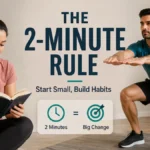
The bigger the behavior, the more motivation it needs to start — and motivation is exactly what you don’t have on a busy day. So you shrink the behavior until it’s almost impossible to refuse: not “do a workout” but “do one squat.” A behavior small enough to do on your worst day is a behavior that keeps the streak alive, and momentum usually carries you past the minimum anyway.
This connects directly to the practice of micro-workouts for desk workers — the routines are deliberately small precisely because small is what survives. The behavioral logic behind it is in why 2-minute habits beat ambitious ones.
What Happened When I Rebuilt My Own Routine Using These Rules
I’d failed at “exercise more during the workday” at least four times. Each attempt started strong and died within two weeks — always during a busy stretch. So I ran one more attempt, but this time built strictly on the three levers above, and tracked it for 66 days (the number from the Lally study felt like a fitting test length).
The setup: I wrote three explicit if-then plans and stacked each onto an existing habit — after my first coffee, 10 squats; after any call ends, a 20-second stand-and-stretch; after I shut my laptop at day’s end, a 2-minute walk. The minimum bar on a bad day was a single rep of each.
What I tracked: daily completion of each of the three stacks, and a weekly 1–10 rating of how “automatic” each one felt.
What happened:
- The two stacks tied to rock-solid cues (coffee and laptop-close) stuck fast. By around week four they felt automatic — I was doing them before I’d consciously decided to. The automaticity rating for the coffee stack climbed from 2/10 in week one to about 8/10 by week six.
- The “after any call” stack was shakier, because my call schedule was irregular — proof that the reliability of the cue matters as much as the plan itself.
- I missed days. Plenty of them. Two work trips blew up the routine entirely. But — exactly as the Lally research predicted — picking back up the next day didn’t undo the progress. The habit was still there.
- The tiny minimum was the safety net. On my most overloaded days, doing the single-rep version was what kept me from declaring the whole thing “broken” and quitting — which is what had killed every previous attempt.
The honest takeaway: the difference between this attempt and my four failures wasn’t discipline. It was design. Same me, same busy schedule — different system. Our full approach to testing is on our methodology page.
Your 4-Week Plan to Build One Habit That Lasts
Don’t build five habits at once — you’ll split your focus and lose them all. Build one, let it become automatic, then add the next.
Week 1 — Choose and Anchor. Pick one tiny movement (e.g., 10 squats). Write one if-then plan anchoring it to an existing, rock-solid daily habit. Do only this.
Week 2 — Protect the Cue. Keep going. Notice whether your chosen cue actually fires reliably. If it doesn’t (like my “after any call” stack), swap it for a more dependable one.
Week 3 — Allow Imperfection. You’ll miss a day this week. Good — practice the most important skill: doing the tiny version, or simply resuming the next day without guilt. See how to restart an exercise habit without guilt.
Week 4 — Let it Settle, then Stack. Only once the first habit feels semi-automatic should you add a second, using the same method. Remember the real timeline is closer to 66 days than 21, so be patient 3.
The Mindset Shifts That Make This Work
Beyond the tactics, a few reframes separate people who stick from people who restart forever:
- Systems over goals. A goal (“get fit”) is a direction; a system (“after coffee, I move”) is what actually gets you there. Build the system and the goal follows. More on this in the motivation myth.
- Consistency over intensity. Ten easy reps every day beats a heroic session once a fortnight — both for results and for habit formation, which is built purely on repetition 2.
- Never miss twice. One missed day is noise and doesn’t hurt the habit 3. Two missed days is the start of a new (bad) pattern. The rule isn’t “never miss” — it’s “never miss twice.”
- Track it, lightly. A simple checkmark each day provides feedback and a streak worth protecting. We compare ways to do this in tracking micro-workouts: apps vs. paper.
Common Mistakes That Break the Habit
- Starting too big. “I’ll do 30 minutes every morning” needs more motivation than a busy week can supply. Start embarrassingly small.
- Relying on motivation. Motivation is the spark, not the engine. Build cues that fire whether you feel like it or not 2.
- Choosing a flaky cue. If the anchor habit isn’t truly reliable, the stack won’t be either. Pick something you do every single day, without exception.
- Quitting after one miss. This single error ends more habits than anything else — and the science says one miss is harmless 3.
- Expecting it fast. If you quit at day 21 because it “isn’t automatic yet,” you quit right in the middle of the normal timeline 3.
Frequently Asked Questions
Que1. How long does it really take to build an exercise habit?
Ans . A median of about 66 days, but it ranges widely from roughly 18 to 254 days depending on the person and behavior 3. The “21 days” figure is a myth.
Que2. What’s the single most effective technique?
Ans . Implementation intentions — specific if-then plans — are the most strongly supported tool in the research 4. Pair them with habit stacking.
Que3. Does missing a day ruin my progress?
Ans . No. The research found a single missed opportunity didn’t meaningfully harm habit formation 3. Just don’t miss twice in a row.
Que4. Why do I keep failing even though I’m motivated?
Ans . Because motivation isn’t the bottleneck — about half of all exercise intentions never become behavior, even in motivated people 1. The fix is a cue-based system, not more willpower.
Que5. Should I build several habits at once?
Ans . No. Build one until it’s automatic, then add the next. Splitting focus across many new habits is a common way to lose all of them.
Your Next Step
Here’s the truth this whole guide rests on: you don’t need to want it more. You need to design it better. The most disciplined-looking people aren’t grinding through willpower — they’ve just built systems that make the right action automatic.
So do one thing right now. Pick a single tiny movement and one rock-solid daily cue, and write this sentence down: “After I ___, I will ___.” That single if-then plan is the most evidence-backed first step you can take.
Then go deeper:
- Habit stacking for desk workers
- Why 2-minute habits beat ambitious ones
- How to restart an exercise habit without guilt
And to put your new habit to work, start with the routines in the hub: micro-workouts for desk workers.